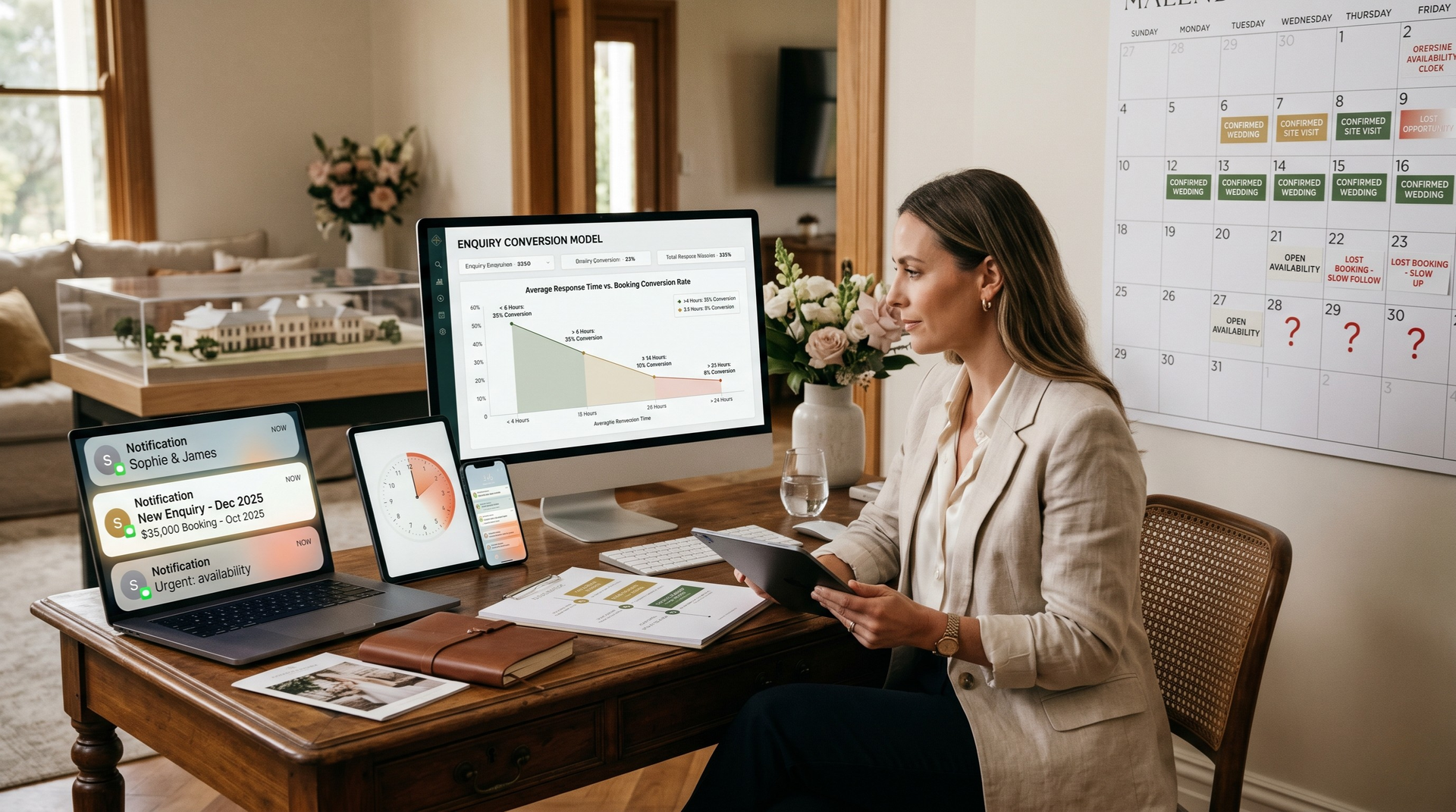
It is easy to talk about ‘lost leads’ in the abstract. This article puts specific numbers to the problem — using conservative assumptions, a worked example, and a model you can apply to your own venue.
Why the Cost Is Hard to See
The challenge with revenue lost to slow enquiry response is that it is invisible by design.
Your CRM shows you the leads that converted. It also shows you the leads you followed up and received a response from.
What it does not show you are the leads that arrived, received no response within the window that mattered, went cold, and silently moved on.
Those leads are not recorded as lost. They are simply absent.
There is no line in your reporting that reads: “Three Sunday evening enquiries failed to convert because they waited 14 hours for a response.” The damage is real, but it leaves no trace in standard reporting systems.
This invisibility has a practical consequence: most venues systematically underestimate the revenue impact of their response time gap.
They cannot see the problem clearly, so they do not address it with the urgency it deserves.
This article attempts to make the invisible visible.
Using a worked example built on conservative, defensible assumptions, we will put a specific dollar figure to the cost of the after-hours response gap for a typical Australian wedding venue.
You can then adjust the variables to reflect your own situation.
The leads lost to slow response are invisible in your reporting. They don’t show as lost — they simply never appear at all.
The Worked Example: Venue Profile
To keep the model grounded, we will use a specific venue profile for our worked example. This profile is representative of a mid tier Australian wedding venue, not the largest or most premium in the market, but a well regarded venue with a genuine marketing investment and a professional team.
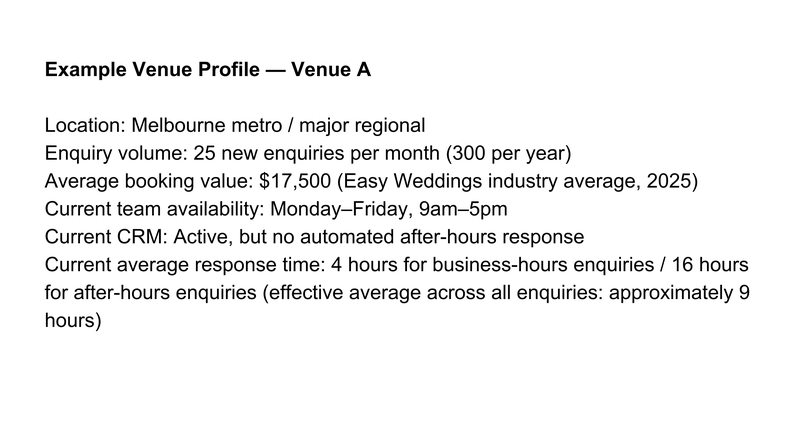
Step 1: Identify the After Hours Enquiry Volume
Based on patterns observed across the RealWeddings platform, approximately 45% of wedding venue enquiries arrive outside standard business hours, evenings, weekends, and public holidays.
For Venue A, this looks as follows:
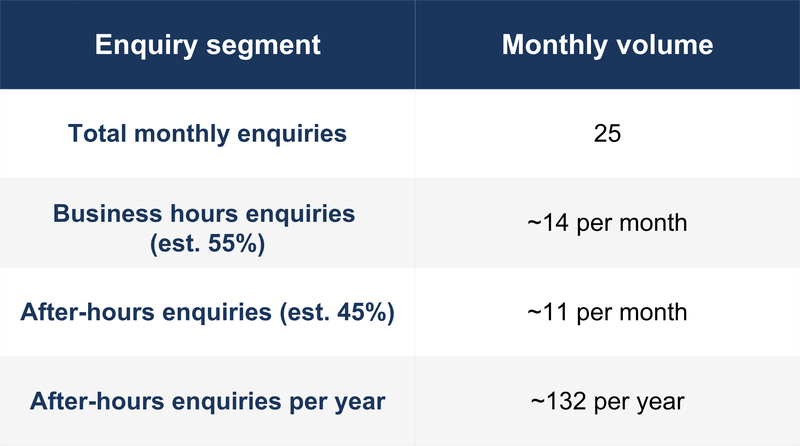
These 132 after hours enquiries per year are the ones at risk. They are the enquiries that arrived when no one was available, that waited 12 to 18 hours for a first response, and that received that response into a fundamentally different emotional context from the one in which they were sent.
Step 2: Estimate the Conversion Rate Differential
This is the key variable in the model, and it is also the one where we need to be most careful about the assumptions we make.
We know from the MIT Lead Response Management Study that the probability of successfully contacting a lead drops 100 times between a 5-minute response and a 30-minute response.
We do not have a published, venue-specific study on the conversion rate differential between immediate and delayed responses in the Australian wedding market.
What we have is a directional finding from the best available research, applied conservatively.
For this model, we will use two scenarios: a conservative estimate and a moderate estimate.
We deliberately avoid an aggressive estimate. Our preference is for claims that can be defended rather than figures that maximise the apparent opportunity.
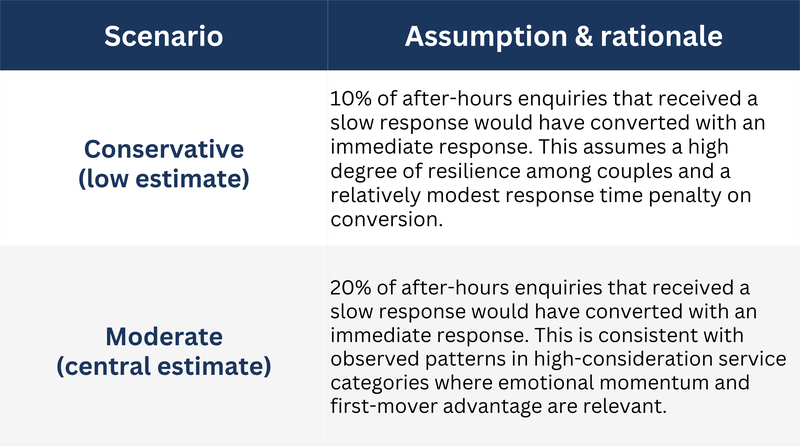
Step 3: Calculate the Revenue Impact
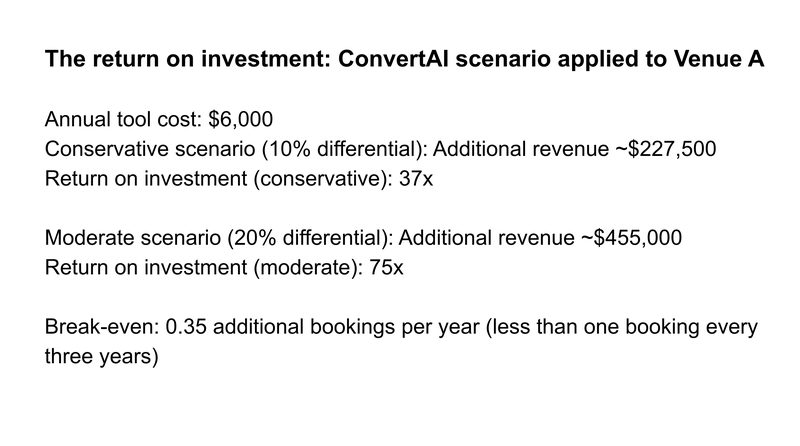
Applying both scenarios to Venue A’s after hours enquiry volume: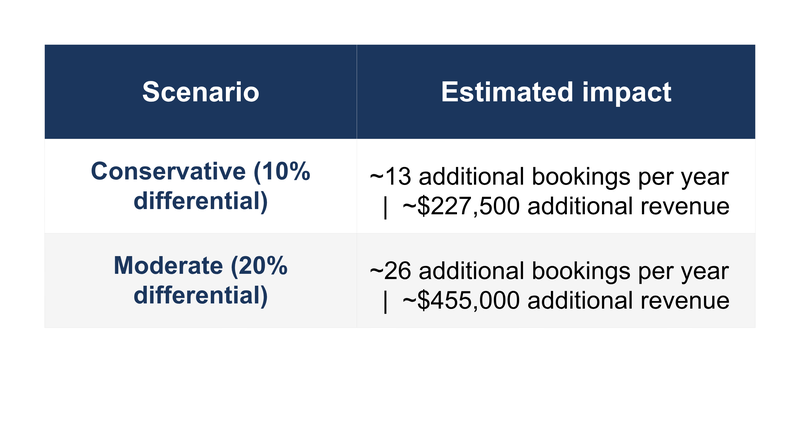
These numbers warrant a moment of reflection.
Even the conservative scenario—which assumes that only one in ten after-hours enquiries would have converted differently with an immediate response—produces an annual revenue impact of $227,500.
For a venue generating, say, $1.5 million to $2 million in annual booking revenue, that represents a 10 to 15 percent revenue uplift from a single operational change.
The moderate scenario, which is arguably the more realistic of the two given the weight of the contact rate research, suggests a revenue impact approaching half a million dollars per year.
We are not presenting these numbers as guaranteed outcomes from implementing an after-hours response tool.
We are presenting them as an estimate of the revenue currently being left unrealised by the structural gap between when couples enquire and when venues respond.
How much of that gap can be closed in practice depends on the quality of the response infrastructure, the specific venue’s competitive position, and a range of other factors.
A note on assumptions
The conservative scenario (10% conversion differential) is deliberately cautious. It implies that 90% of after-hours enquiries would convert at the same rate regardless of response time — a position that is difficult to defend given the contact rate research but reflects appropriate epistemic humility about the specific wedding category. The moderate scenario (20%) is consistent with observed patterns in comparable high-consideration service categories.
Step 4: Compare Against the Cost of a Solution
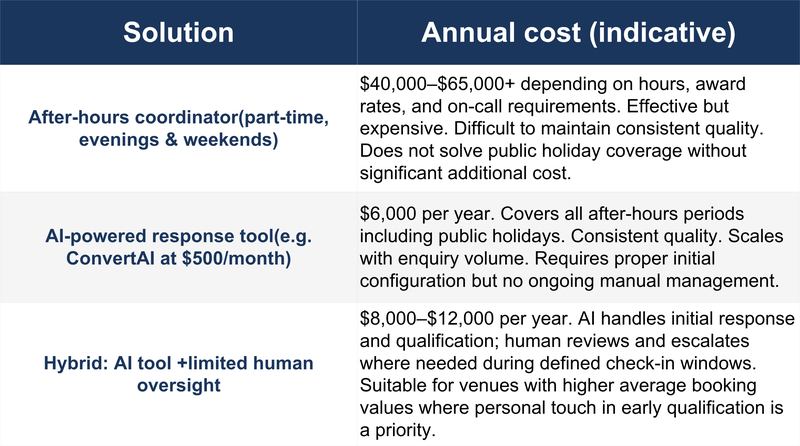
The revenue impact numbers above become meaningful in context when set against the cost of addressing the problem. There are three broad options, each with a different cost structure:
Applying This Model to Your Own Venue
The Venue A model uses specific assumptions that may not reflect your situation. Here is how to adapt it:
Enquiry volume: Use your actual monthly enquiry count from the past six months, averaged.
After hours proportion: If you haven’t audited your enquiry timestamps, use 40–45% as a reasonable starting estimate for most Australian venues.
Average booking value: Use your actual average net venue revenue per wedding booking, not gross spend.
Conversion differential: We recommend using the conservative 10% figure for any internal business case. This produces the most defensible estimate and is least vulnerable to challenge.
Solution cost: Get a specific quote for whatever response infrastructure you’re evaluating. The comparison only works with real numbers.
Run the model with your own numbers and see what it produces. The output will tell you whether the revenue opportunity is large enough relative to the cost of the solution to justify action. For the overwhelming majority of venues with 15 or more monthly enquiries and average booking values above $10,000, the case will be clear.
The Harder Question
The financial model is useful because it makes a diffuse problem concrete.
But there is a harder question underneath it that the numbers alone do not answer: what is the cost of knowing this problem exists and choosing not to address it?
Every month that a venue continues operating without after-hours response capability is a month in which the conservative scenario is playing out.
Leads are arriving. Responses are delayed.
Some of those leads are converting at a lower rate than they would have with an immediate response.
Revenue is being left unrealised from marketing spend that has already been made.
The financial model suggests that for a venue like the example above, the ongoing cost of inaction is in the range of $19,000 to $38,000 per month in unrealised revenue potential.
Over a year, that is a significant number. Over three years, it is a transformative one.
Whether that number is large enough to justify immediate action is a decision each venue operator needs to make based on their own circumstances, competitive position, and capacity to implement change.
What the model makes clear is that the cost of inaction is not zero, and it is not small.
The financial model tells you what the problem costs. The harder question is how long you’re comfortable paying that cost.
Want to see it in practice?
ConvertAI is an AI sales assistant built specifically for Australian wedding and event venues, by the team behind RealWeddings.com.au. It responds instantly across web chat, email, WhatsApp, Meta, and web forms and is fully configured and trained by our team before going anywhere near your inbox.
Run the numbers with your own venue → convertai.com.au