
AI tools for wedding venues are moving from novelty to mainstream. But the marketing around them can be hard to cut through. This is a plain language guide to what these tools actually do, where they add genuine value, and what to look for before committing.
The Conversation Every Venue Manager Is Having Right Now
If you’ve attended a wedding industry conference in the past twelve months, sat in a supplier briefing, or simply scrolled through a Facebook group for venue operators, you’ve almost certainly encountered the phrase ‘AI sales assistant’.
Some of what you’ve heard will have sounded genuinely useful.
Some of it will have sounded like technology vendors solving a problem you’re not sure you have.
And some of it, particularly the more breathless claims about automation and revenue transformation, may have made you appropriately sceptical.
That scepticism is healthy.
This guide is an attempt to cut through the noise and give venue operators a clear, honest picture of what AI tools in this category actually do, where the genuine value lies, and what questions to ask before deciding whether one belongs in your business.
The Problem These Tools Are Built to Solve
Before evaluating any tool, it helps to be clear about the underlying problem it is designed to address.
Wedding enquiries do not arrive on a schedule.
Couples research venues in the evenings and on weekends, the times when they have uninterrupted time and are emotionally engaged in the planning process.
A Sunday evening at 9pm is, in practice, one of the most active enquiry periods for Australian wedding venues.
The challenge is that this is also when venue teams are least available.
The result is a structural gap: high intent leads arriving outside business hours, sitting unanswered for hours or sometimes days, and cooling significantly in the interim.
Research from the MIT Lead Response Management Study, cited in Harvard Business Review, found that the likelihood of successfully making contact with a prospect drops 100 times between a 5-minute response and a 30-minute response.
For enquiries that wait until the next business day, the contact odds are negligible by comparison.
Couples planning a wedding typically reach out to multiple venues simultaneously. They are not waiting for your response before continuing their search.
The venue that responds first, intelligently and helpfully, not just with an autoresponder acknowledgement, earns a disproportionate share of the couple’s shortlist consideration.
This is the gap that AI sales assistants are designed to close.
What an AI Sales Assistant Actually Does
The term ‘AI sales assistant’ covers a wide range of products with meaningfully different capabilities.
At the basic end, some tools are sophisticated autoresponders.
At the more capable end, they hold genuine, context aware conversations that feel like interacting with a knowledgeable team member.
Here is what the better tools in this category are capable of:
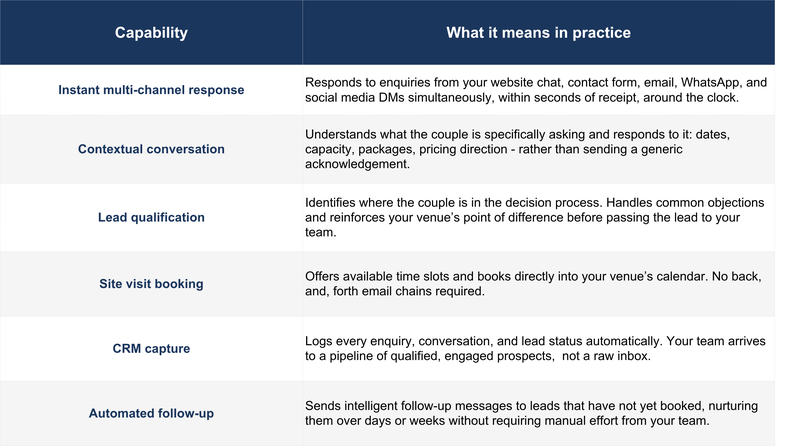
It is worth being clear about what these tools do not do.
They do not close weddings.
They do not replace the site visit, the personal connection, the judgment of an experienced events coordinator, or the human relationship that ultimately drives a booking decision.
What they do is ensure that the lead is still warm and engaged when the human team picks it up with a site visit, potentially already in the calendar.
The AI doesn’t close the wedding. It makes sure your team gets the opportunity to.
The Three Concerns Most Venue Teams Raise
In conversations with venue operators and events managers across Australia, the same concerns come up consistently. They are worth addressing directly.
“Couples will know it’s a bot.”
This concern was more valid two or three years ago than it is today.
AI tools that are properly configured for a specific venue, trained on your spaces, packages, pricing parameters, availability calendar, and the language your team uses.
They can hold conversations that are virtually indistinguishable from a knowledgeable team member for the vast majority of standard enquiry interactions.
It is also worth noting that the primary expectation of today’s engaged couples, predominantly millennials and Gen Z, is not a phone call.
It is a fast, accurate, helpful response. The medium matters far less than the quality and speed of the answer.
“AI will replace my staff.”
It will not, and the better tools in this category are designed with this explicit understanding.
What AI handles is the repetitive, time sensitive work that humans are poorly positioned to do at 10 pm on a Sunday: initial response, qualification, basic Q&A, and calendar booking.
What it hands off to your team is a qualified lead: a couple who has already been engaged, had their preliminary questions answered, and in many cases, scheduled a site visit.
Teams that implement AI sales assistants typically find their coordinators spend more time on the high-value work they were hired for: site visits, personal relationship building, event planning, and less time on inbox management and chasing cold leads.
“We’ll manage it with better processes.”
Some venues can. If your team genuinely responds to every enquiry within minutes, regardless of when it arrives, including Sunday evenings and public holidays, then a technology solution may add less marginal value for you than for most.
For the majority of venues, however, this is an aspiration rather than a reality.
After-hours coverage is expensive to staff and difficult to sustain consistently.
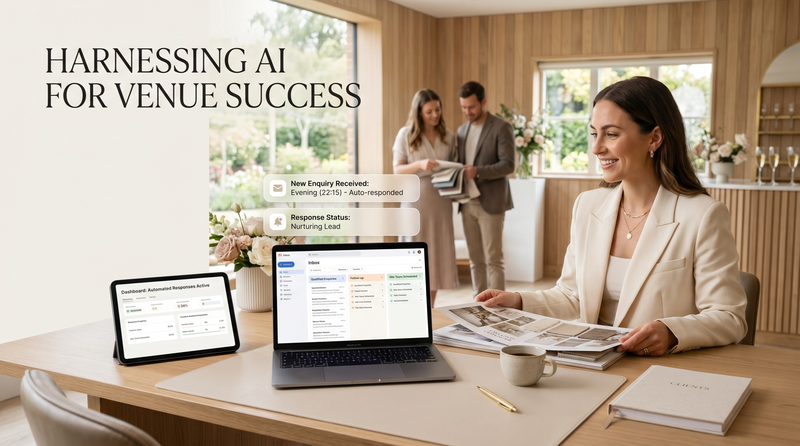
The structural gap; peak enquiry volume arriving outside business hours, does not close by asking the team to respond faster during business hours. The problem is architectural, not motivational.
How to Think About the Return on Investment
The right question is not the cost of the tool. It is: what is the value of a single additional booking, and how many would this tool need to generate to pay for itself?
At an average Australian wedding booking value of $17,500, a venue paying $300 - $500 per month for an AI solution needs to convert less than one additional booking per year to break even on the subscription alone.
The more useful framing is opportunity cost.
How many after hours enquiries does your venue receive each month?
Of those, how many receive a response within the critical five-minute window?
What is the likely revenue impact of the leads that go cold in the interim?
Most venues, when they look at this honestly, find the answer is not comfortable.
Six Questions to Ask Before Committing to a Tool
1. Is it purpose-built for the venue and events category?
A general purpose AI tool can be configured to discuss your venue, but it will lack a specific understanding of how wedding enquiries work; the typical questions, the decision timeline, the emotional register of the conversation, and common objections.
In this category, specific tools perform meaningfully better.
2. Which channels does it cover?
Your enquiries do not all arrive through the same channel. Website chat, email, contact forms, Instagram DMs, WhatsApp; a tool that covers only one or two leaves gaps.
Look for multi-channel coverage that consolidates all threads into a single CRM view.
3. How is it trained and configured for your specific venue?
The quality of an AI assistant is directly proportional to the quality of its training. Ask specifically how the tool is configured; what information it is trained on, how it is updated as your packages or availability change, and who is responsible for that maintenance.
4. Does it integrate with your existing calendar and CRM?
A tool that books site visits into your calendar and logs leads into your CRM saves significant manual effort and reduces the risk of handoff gaps. If it requires a separate reconciliation workflow, much of the efficiency gain is lost.
5. What does the onboarding and support model look like?
Tools that require significant technical setup on your side add friction and delay. The better products are configured and launched by the vendor, with your input on venue specifics, rather than requiring your team to become technical administrators.
6. Is there a lock-in contract?
This is a rapidly evolving category.
A long term lock-in contract is a material risk when the tools themselves are still maturing.
Look for month to month arrangements or short pilot periods that allow you to evaluate performance against your real enquiry data before committing to a longer term.
Is Now the Right Time?
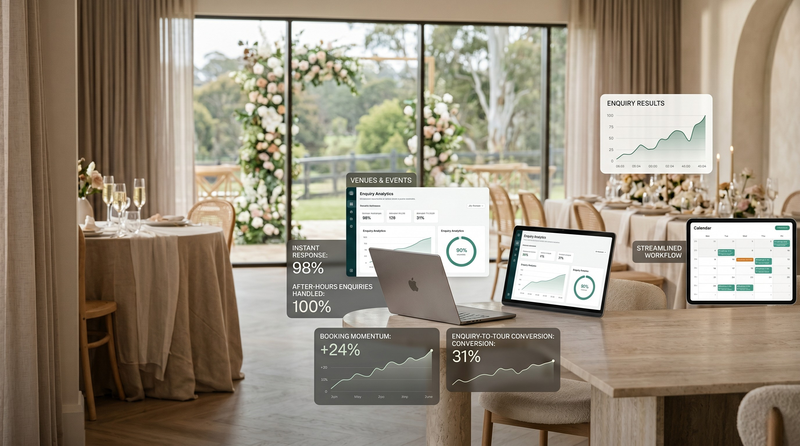
There is a reasonable argument that the best time to implement infrastructure like this is when your venue is under the least pressure, i.e. when bookings are strong, the team has capacity, and the setup can be done properly.
Waiting until conversion is already a problem means setting it up in conditions where the margin for error is smaller.
There is also a competitive argument.
Venues in your market that adopt this infrastructure first will build a structural advantage in response speed that will be difficult for slower movers to close.
Couple’s expectations around response time move in one direction only.
The standard that was acceptable three years ago is already below what today’s couples expect, and the standard in three years will be higher still.
The Australian wedding market generates approximately 120,000 weddings per year (ABS).
The venues capturing a growing share of that market over the next three to five years will almost certainly be those that have aligned their enquiry infrastructure with how couples actually behave, not how venue teams would prefer them to behave.
Couple’s expectations around response speed move in one direction only. The standard that was acceptable three years ago is already below what today’s engaged couples expect.
The Bottom Line
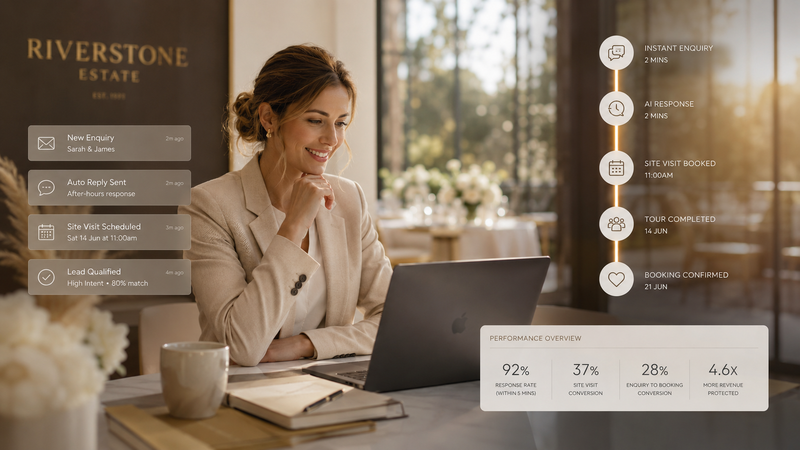
An AI sales assistant will not fix a weak value proposition, a poorly designed enquiry process, or a team that lacks the skills to convert a site visit into a booking. It is not a substitute for any of those things.
What it will do, if well-configured and properly integrated, is close the gap between when couples enquire and when they hear from you, consistently, across every channel, at every hour of the day.
For most Australian venues, that gap is currently costing real revenue from leads that existing marketing budgets are already paying to generate.
The questions worth knowing the answers to are straightforward: how many of your enquiries arrive outside your current response window, and what is each one of those leads worth?
The answer to those two questions will tell you most of what you need to know about whether this category of tool is relevant for your business.
Want to see it in practice?
ConvertAI is an AI sales assistant built specifically for Australian wedding and event venues, by the team behind RealWeddings.com.au.
It responds instantly across web chat, email, WhatsApp, Meta, and web forms and is fully configured and trained by our team before it goes anywhere near your inbox.
Book a 20-minute demo here